
CNN
–.
The consistent heat dome which enforced oppressively high temperature levels on the northern Plains and Midwest over the weekend will start to move more eastward today, ending a brief reprieve lots of states in the Great Lakes and Mid-Atlantic have actually had in current days.
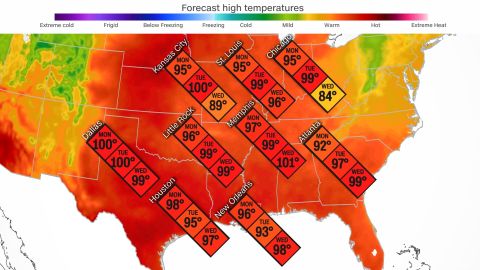
In the coming week, about 70% of the US population will see temperature levels in the 90s, and nearly 20% of individuals in the nation will experience temperature levels higher than 100 degrees. Lots of significant city locations, consisting of Minneapolis, Chicago, Nashville, Memphis, Dallas, New Orleans and Atlanta, might experience temperatures near or above100
More than 100 high temperature records could be broken today, generally throughout the southern and eastern areas of theUS
In Minnesota, where cities like St. Paul and Minneapolis are under a severe heat caution, roadways are currently beginning to give in the heat, consisting of 2 in the Minneapolis location, CNN affiliate KARE reported
Lots of locations anticipated to set records were likewise struck with severe heat recently when a huge heat dome brought triple-digit temperature levels to states throughout the eastern US and Midwest, exceeding daily highs in a number of cities.
This previous weekend saw a number of brand-new day-to-day record high temperature levels, consisting of in New Orleans, which clocked a high of 97 degrees, and in Mobile, Alabama, which exceeded its 1913 record of 100 degrees when it inched as much as 101 degrees on Saturday.
As of early Monday early morning, more than 9 million individuals were under heat informs throughout 8 states in the northern and main US, consisting of Minnesota, Iowa, North Dakota, South Dakota, Michigan, Wisconsin, Nebraska and Kansas.
However this number is anticipated to increase throughout the week as the heat continues to construct throughout the northern Plains, Midwest and Gulf Coast on Monday, possibly bringing triple-digit temperature records as it advances into the Southeast and Mid-Atlantic on Tuesday.
Lots of neighborhoods fighting the heat might not get much relief during the night, either, as there are an extra 100 record high over night low temperature levels anticipate to be broken throughout the week.
The continuing heat follows a week in which severe weather condition struck countless individuals throughout theUS In addition to the huge heat dome, historical flooding swamped Yellowstone National forest and its surrounding neighborhoods, wildfires blazed in Arizona and New Mexico, and serious storms in the upper Midwest and Ohio River Valley triggered extensive power blackouts.
Numerous countless individuals, consisting of about 180,000 in Ohio, needed to sustain extreme heat wave temperature levels without electrical energy due to the blackouts.

Though the majority of heat- associated diseases are avoidable through outreach and intervention efforts, they are still the leading reason for weather-related deaths in the US, according to the US Epa
Incredibly high temperature levels can cause typical heat- associated conditions such as heatstroke and heat fatigue, which happen when the body is not able to effectively cool itself. It can likewise enforce substantial stress on the heart and make breathing harder.
Babies, kids, the senior and individuals with persistent diseases or psychological illness are particularly susceptible to heat- associated diseases, though young and healthy individuals might be impacted, too, if they are doing laborious activity in extreme temperature levels, according to the CDC
While kids do not pass away from heat- associated diseases as much as the senior, a research study released in January discovered “environment shocks” like sweltering heat waves can cumulatively impact a kid’s long-lasting health. Gradually, such occasions might add to considerably greater rates of compound abuse and illness like cancer and heart problem, scientists stated
As environment modification drives temperature levels greater, researchers anticipate heat to make more individuals ill, particularly due to the fact that heat waves are ending up being more regular.
In the 1960s, Americans saw approximately 2 heat waves a year, however by the 2010s, the average increased to 6 each year, according to the EPA.