

CLASSIFICATION 1 CME
Best Date: January 20, 2023
Expiration Date: July 20, 2024
This activity provides CE credits for:
1. Physicians (CME)
2. Other
All other clinicians either will get a CME Participation Certificate or might select any of the kinds of CE credit being provided.
ACTIVITY OBJECTIVE
The objective of this activity is to comprehend how recovery-oriented cognitive treatment (CT-R) promotes health and empowerment for people experiencing severe psychological health difficulties.
DISCOVERING GOALS
1. Explain 3 of the elements that underlie and direct the theory of CT-R.
2. Recognize a minimum of 1 technique that can be utilized in each of the core parts of CT-R.
TARGET MARKET
This certified continuing education (CE) activity is meant for psychiatrists, psychologists, medical care doctors, doctor assistants, nurse specialists, and other healthcare specialists looking for to enhance the care of clients with psychological health conditions.
ACCREDITATION/CREDIT DESIGNATION/FINANCIAL ASSISTANCE
This activity has actually been prepared and carried out in accordance with the accreditation requirements and policies of the Accreditation Council for Continuing Medical Education (ACCME) through the joint providership of Physicians’ Education Resource ®, LLC, and Psychiatric Times ™. Physicians ‘Education Resource ®, LLC, is certified by the ACCME to supply continuing medical education for doctors.
Physicians’ Education Resource ®, LLC, designates this withstanding product for a optimum of 1.5 AMA PRA Classification 1 Credits ™. Physicians ought to declare just the credit commensurate with the degree of their involvement in the activity.
This activity is moneyed totally by Physicians’ Education Resource ®, LLC. No industrial assistance was gotten.
OFF-LABEL DISCLOSURE/DISCLAIMER
This certified CE activity might or might not talk about investigational, unapproved, or off-label usage of drugs. Individuals are recommended to speak with recommending details for any items gone over. The details offered in this certified CE activity is for continuing medical education functions just and is not suggested to replacement for the independent medical judgment of a doctor relative to diagnostic or treatment alternatives for a particular client’s medical condition. The viewpoints revealed in the material are exclusively those of the specific professor and do not show those of Physicians’ Education Resource ®, LLC.(* )PROFESSORS, PERSONNEL, AND COORDINATORS’ DISCLOSURES AND DISPUTES OF INTEREST (COI) MITIGATION
None of the personnel of Physicians’ Education Resource ®, LLC, or Psychiatric Times ™ or the organizers of this instructional activity have appropriate monetary relationship( s) to reveal with disqualified business whose main company is producing, marketing, selling, reselling, or dispersing healthcare items utilized by or on clients. Drs Grant and Inverso note they have absolutely nothing to reveal concerning this short article.
For content-related concerns, email us at
PTEditor@mmhgroup.com For concerns worrying the accreditation of this CE activity or how to declare credit, please contact info@gotoper.com and consist of ” Recovery-Oriented Cognitive Treatment: Promoting Greater Quality of Life”a in the subject line. Unidentified block type “hrtag”, define
element for it in the ‘components.types’ propa People with severe psychological health conditions, such as schizophrenia, will pass away, typically, nearly 3 years earlier than members of the basic population.
1 This increased death is the outcome of medical diseases (eg, kidney illness, cardiovascular disease, weight problems, type 2 diabetes, compound usage conditions). 2 Sadly, the empirically supported psychiatric treatments for schizophrenia (eg, psychosocial rehab, pharmacotherapy, cognitive treatment for psychosis) reveal little effectiveness in reversing this death pattern. 3 2 of the most popular social factors of health and health– function and connection 4,5— are frequently missing out on in the lives of people with medical diagnosis of schizophrenia. Poor diagnosis is likewise related to treatment dropout or a absence of engagement in treatment.a 6 Recovery-oriented cognitive treatment
7 (CT-R) is developed to fulfill the call for more personally appropriate treatment techniques. 8 By concentrating on individualized connection, active function, and the pursuit of one’s preferred life, in addition to empowerment relative to life’s stress factors, 9 CT-R intends to promote high quality of life and transformative health.a The CT-R approach consists of useful methods and interventions that consist of recovery-oriented treatment, which has actually been the required for care in the United States considering that the 2002 publication of the President’s New Liberty Commission on Mental Health report.
10,11 As an action-based, whole-person approach, CT-R applies throughout the human age variety and fits flexibly into the scope of practice of health specialists and paraprofessionals operating in wide range of care shipment settings. CT-R has actually been carried out as a private and group intervention; it has actually been the basis of milieu-based shows; it has actually assisted treatment efforts of community-based groups; it has galvanized peer professional work; and it has actually produced recovery-oriented care while preserving security in forensic contexts.a 12 The 3 Specifying Concepts
We established CT-R in collaboration with Aaron T. Beck, MD. 3 of Beck’s primary contributions to medication are trademarks of the approach and can be discovered in the
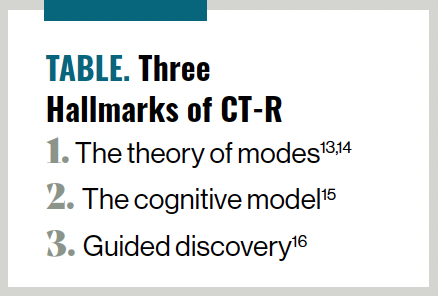
3 Trademarks of CT-R The theory of modes and the cognitive design.
CT-R theory embeds the cognitive design within the theory of modes ( Figure 1) to produce whole-person understanding of how each specific flourishes (the a adaptive mode) and how they can get captured up in myriad difficulties (the detached mode). CT-R is based upon the medical observation that anybody can rapidly alter in between favorably oriented and adversely oriented modes of living. Figure 1.
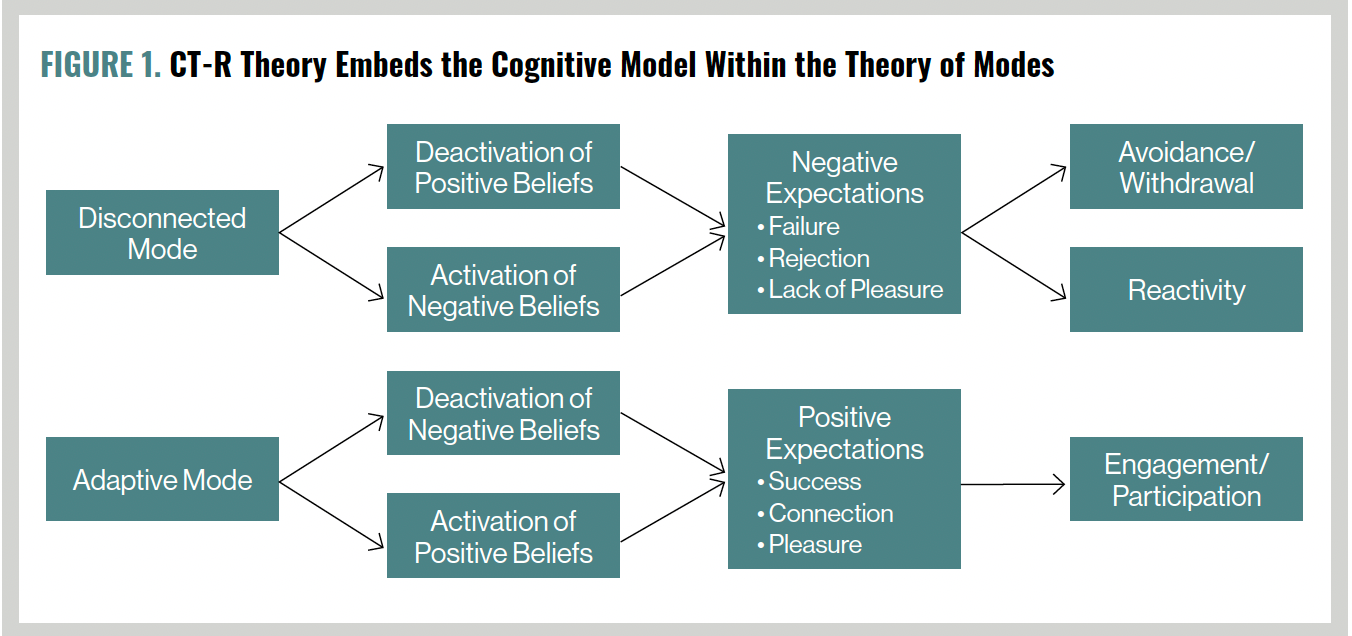
CT-R Theory Embeds the Cognitive Design Within the Theory of Modes Suppliers can find the adaptive mode by asking what a person resembles at their finest: When is their affect better, their interaction clearer, their energy improved? What are they performing in these times? Triggering the adaptive mode makes favorable beliefs– such as the capability to link, contribute, and be valued– end up being more available, be accepted higher conviction, and timely favorable expectations for satisfying, significant, or aspiration-driven action.
This favorable cognitive triad– self, others, future– of the adaptive mode contrasts with the detached mode. In the detached mode, which is controlled by higher activation of unfavorable beliefs, the person might view themselves as incapable, doing not have function, or being broken. As a result, they reveal unfavorable expectations about the future (eg, “I will not take pleasure in doing things” or “I can’t do anything”). They might react to these beliefs with unfavorable signs of withdrawal and seclusion or with reactive habits like self-injury, aggressiveness, or
compound usage It appears when people remain in the detached mode based upon how they explain themselves, how they react when provided with chances to take part in activities, or how dominant their psychiatric signs are, such as unduly addressing acoustic hallucinations, revealing persecutory beliefs, or acting strongly. Assisted discovery and favorable action.
At the start of treatment, the detached mode is quickly triggered, and the specific invests out of proportion quantity of time in it. CT-R methods and interventions intend to make the person’s finest self actively control their experience. Assisted discovery concerns (eg, “What does that state about you?”) turn this favorable action into individual significances that empower the specific to grow and sustain the life of their picking.a The experiential procedure starts in discovering activities to do together to access the adaptive mode. Making these activities happen more frequently and including others stimulates it. Foreseeable shared activity makes CT-R attractive, satisfying, and worth continuing. It likewise produces
significant connection and social trust, which are essential health aspects. Trust can be leveraged to establish the adaptive mode, a procedure by which the specific shares and improves treasured, long-lasting life targets. This procedure influences hope– another crucial health aspect– and causes activity that actualizes the significance of the person’s goals. In this method, the specific lives their worths and experiences function every day, additional highlighting health. Assisted discovery can be used at each of these actions– accessing, stimulating, establishing, and actualizing the adaptive mode– to assist enhance the person’s finest self, cultivating durability and empowerment to sustain their preferred life (a Figure 2). Figure 2.
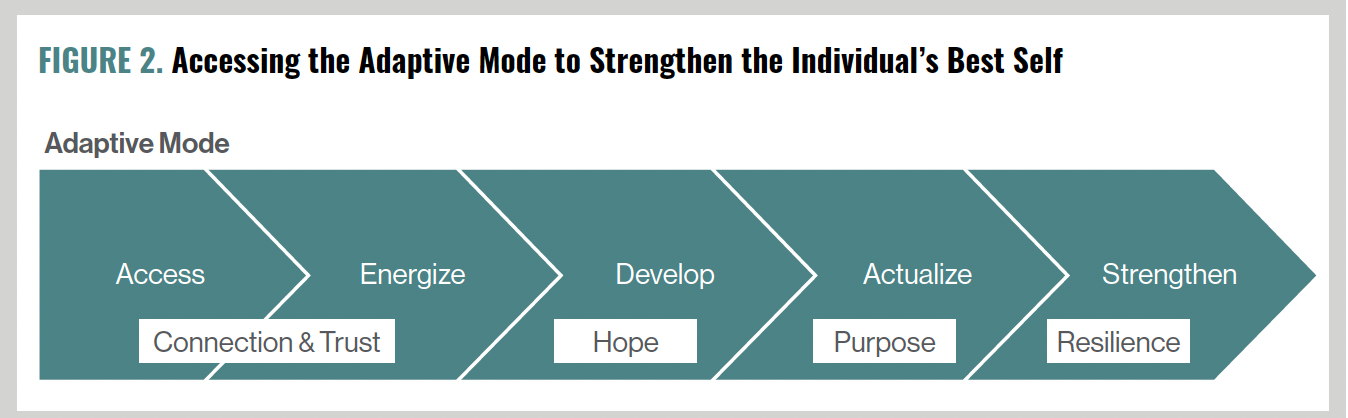
Accessing the Adaptive Mode to Reinforce the Person’s Finest Self Case Example
” Gloria” remains in her home all the time and thinks that she is being kept an eye on by her family home appliances. Having actually cut off interaction with her friends and family, she counts on
case management group to drop off food and other fundamental requirements at the door. Gloria’s group is trained in CT-R, and they choose to utilize it to direct their deal with her.a Accessing and stimulating.
The staff member start by asking themselves why it may be that she will not let them in the door. They think that Gloria thinks she has no control over the tracking which she is afraid much of the time. If they are going to link effectively with her, they will require to provide her control and assist her feel safe. Since members of the group share the very same culture as Gloria, they struck on the concept of asking her about particular dishes. At first, staff member goes to her door and asks low-pressure, choice-based concerns about which kind of spices to utilize (” cumin or cayenne?”). At the next go to, the staff member informs her how scrumptious the meal ended up and draws her attention to how valuable and capable she is, requesting for another cooking suggestion prior to leaving (” tostones or potatoes?”). Quickly staff member go to and ask more open-ended concerns to learn more about brand-new dishes (” Inform me a meal you like that I need to attempt making”).a Gloria concerns anticipate the quick and foreseeable check outs, waiting by the door with her next meal suggestion. The check outs grow longer and more animated; each time, the staff member offers feedback of cooking success and guides her to see how valuable and valued she is. After
few of these discussions, Gloria welcomes the first string member into her home, thrilled to reveal them furnishings and household images. This ends up being the brand-new regimen for the group: Gloria welcomes staff member warmly and takes them inside; they listen to music from the old nation, speak about family and friends, and make a significant meal from their culture together.a Establishing.
Gloria’s trust of the group suggests the time may be ideal to inquire about goals. “If you weren’t here with me now preparing on Tuesday at 11 am, what would you wish to be doing?” Taking a minute, Gloria smiles and stated she would be teaching her grandchildren about their household history and singing tunes with them that her grandparents taught her. In later on check outs, Gloria reveals a desire to reconnect with old pals and to offer at her church. Noticing a path to inspiration and potentially to Gloria leaving her home, a staff member asks Gloria for more information: “It seems like teaching your grandchildren and doing things with them is truly crucial to you. What would the very best day with them appear like? Paint me a photo– I would like to picture this how you see it!” Gloria explains the tunes they would sing and how they might extract the ancestral tree with great deals of lively colors.a The staff member then asks: “What do you believe would be the very best part about doing this with your grandchildren?” Gloria at first appears unpredictable how to react. She had actually not considered this in
very long time, having actually composed it off as difficult. The staff member hones the concern: “I envision for some individuals the very best part would be feeling efficient and active. For others it would be linking. Or possibly it has to do with a worth of customs. Are any of those it for you, or possibly it’s something else?” Gloria enthusiastically reacts: “It has to do with household. Household is the most crucial thing you can have! Household and being linked to your individuals– your history.” “Doing great for others” and “having a location where I belong” are the worths that underly reconnecting with pals and offering at church.a Actualizing.
The favorable feeling Gloria reveals when speaking about her goals and worths leads the treatment group to anticipate that Gloria will wish to talk about taking actions to do those things for genuine. In the next check out to her home, among the staff member inquires about her goals. He signs in to ensure he has it ideal (simply put, what she desires and why). A smile concerns her face; Gloria concurs it is still really crucial to her. “What are some things anybody would require to do to feel part of their household? Would this be teaching or doing something associated to your shared culture? What do you believe that would appear like for you?”a They sit together and jot down all the possible actions. The whole time the method, the staff member describes crucial information of Gloria’s goal to preserve the energy and momentum. Together, they produce
course that satisfies Gloria where she is: enjoying a church service online and potentially establishing a video chat with her kids.a Reinforcing.
At every action along the method, the group assists Gloria see crucial significances in what she is doing. Throughout the early contacts, the group concentrates on broadening frequency of activity and variety of connections (” I truly am enjoying this; how about you? Should we do it once again?” “Would you wish to do this with other members of the group?”). With time, the group directs the focus to the success Gloria is having with them (” Wow, you truly taught me how to season the meal much better than ever; what does that state about you?” “You need to be respectable and patient instructor to assist me, huh?”). Later on, the group houses in on the link in between existing actions and Gloria’s goals (” Every day we get up, log into church services, and make a meal together gets you closer to teaching your grandchildren, a offering, and getting in touch with pals– what do you believe?”). A vital part of reinforcing the adaptive mode is durability (” I understand it was not constantly simple to feel safe and comfy letting us can be found in, and here we are weekly cooking more and improving. I question if it’s often worth taking
threat, as things may go much better than you initially believe they will”). Throughout this procedure, Gloria sees herself as progressively more capable, important, linked, and safe.a Emerging Proof
As holds true of all empirically supported techniques, the proof base for CT-R is emerging. Comprehensive, multimethod literature supports the conceptual design of the unfavorable beliefs of the detached mode for people who get
medical diagnosis of schizophrenia.a 17 The favorable beliefs of the adaptive mode are simply starting to discover assistance in the literature. 18,19 Arise From randomized regulated trial including blind raters support the effectiveness of CT-R over basic care in the neighborhood to enhance practical results, lower avolition- lethargy, and lower favorable signs,a 20 and gains were preserved over follow-up duration throughout which the treatment was withdrawn.a 21 In program examination research studies, CT-R has actually been related to decrease in making use of coercive control approaches, 22 a boost in variety of days in the neighborhood, a boost in hope, and the accomplishment of a minimum of 1 Drug abuse and Mental Health Providers Administration healing measurement. 12 Concluding Ideas
CT-R offers useful methods and interventions to promote preferred lives, lower death, and improve growing in the face of life’s frequently really tough difficulties. It is easily found out and produces observable development, as shown by Gloria’s course of treatment. Collective action produces
richer, preferred life, empowered for vexing difficulties. CT-R closes the range in between people who get severe psychological health medical diagnoses and everybody else.a Dr Grant
is director of research study, development, and practice at Beck Institute Center for Recovery-Oriented Cognitive Treatment (CT-R) in Bala Cynwyd, Pennsylvania. Aaron T. Beck, MD, he came from CT-R and performed fundamental research study to confirm it. He is With coauthor of the books Recovery-Oriented Cognitive Treatment for Serious Mental Health Issues and Schizophrenia: Cognitive Theory, Research Study, and Treatment.a Dr Inverso is director of medical training and application at Beck Institute Center for Recovery-Oriented Cognitive Treatment (CT-R) in Bala Cynwyd, Pennsylvania, and codeveloper of CT-R. Together with Beck and coworkers, she is a coauthor of the book Recovery-Oriented Cognitive Treatment for Serious Mental Health Issues.a Referrals
1. Lee EE, Liu J, Tu X, Palmer BW, et al.
A broadening durability space in between individuals with schizophrenia and basic population: literature evaluation and require action.a Schizophr Res 2018; 196:9 -13. 2. Saha S, Chant D, McGrath J.
An organized evaluation of death in schizophrenia: is the differential death space aggravating with time? Arch Gen Psychiatry 2007; 64( 10 ):1123 -1131. 3. Scull A.
American psychiatry in the brand-new centuries: crucial appraisal. a Psychol Medication 2021; 51( 16 ):2762 -2770. 4. Harding KJ.
The Bunny Result: Live Longer, Better, and Healthier Groundbreaking Science of Generosity.With Atria; 2019. 5. Murthy VH.
Together: The Recovery Power of Human Connection in In Some Cases Lonesome World.a Harper Wave; 2020. 6. Kreyenbuhl J, Nossel IR, Dixon Pound.
Disengagement from psychological health treatment amongst people with schizophrenia and methods for assisting in connections to care: evaluation of the literature.a Schizophr Bull 2009; 35( 4 ):696 -703. 7. Beck AT, Grant P, Inverso E, et al.
Recovery-Oriented Cognitive Treatment for Serious Mental Health Issues. Guilford Press; 2021. 8. Dixon Pound, Holoshitz Y, Nossel I.
Treatment engagement of people experiencing mental disorder: evaluation and upgrade. World Psychiatry 2016; 15( 1 ):13 -20. Released correction appears in World Psychiatry 2016; 15( 2 ):189. 9. Cohen AN, Hamilton AB, Saks ER, et al.
How occupationally high-achieving people with medical diagnosis of schizophrenia handle their signs.a Psychiatr Serv 2017; 68( 4 ):324 -329. 10. Hogan MF.
The President’s New Liberty Commission: suggestions to change psychological healthcare in America. Psychiatr Serv 2003; 54( 11 ):1467 -1474. 11. Davidson L, Rakfeldt J, Strauss J.
The Roots of the Healing Motion in Psychiatry: Lessons Found Out. Wiley; 2010. 12. Grant PM. Recovery-oriented cognitive treatment:
theory-driven, evidence-based, transformative practice to promote growing for people with severe psychological health conditions that applies throughout psychological health systems. National Association of State Mental Health Program Directors. October 2019. Accessed April 14, 2022. a https://www.nasmhpd.org/sites/default/files/TAC_Paper_7_508C_1.pdf 13. Beck AT, Haigh EAP.
Advances in cognitive theory and treatment: the generic cognitive design. Annu Rev Clin Psychol 2014; 10:1 -24. 14. Beck AT, Finkel MR, Beck JS. The theory of modes: applications to schizophrenia and other mental conditions.
Cogn Ther Res 2021; 45:391 -400. 15. Beck AT.
Believing and anxiety: I. distinctive material and cognitive distortions. Arch Gen Psychiatry 1963; 9:324 -333. 16. Beck AT, Rush AJ, Shaw BF, Emery G.
Cognitive Treatment of Anxiety. Guilford Press; 1979. 17. Beck AT, Himelstein R, Grant PM.
In and out of schizophrenia: activation and deactivation of the unfavorable and favorable schemas. Schizophr Res 2019; 203:55 -61. 18. Grant PM, Perivoliotis D, Luther L, et al.
Fast enhancement in beliefs, state of mind, and efficiency following a speculative success experience in an analogue test of recovery-oriented cognitive treatment. Psychol Medication 2018; 48( 2 ):261 -268. 19. Grant PM, Finest M. It is constantly warm in Philadelphia: the adaptive mode and favorable beliefs as
brand-new paradigm for comprehending healing and empowerment for people with severe psychological health difficulties. Provided at: International Cognitive Behavior Modification for Psychosis Beckfest 2019; July 1-2, 2019; Philadelphia, PA.a 20. Grant PM, Huh GA, Perivoliotis D, et al.
Randomized trial to assess the effectiveness of cognitive treatment for low-functioning clients with schizophrenia. Arch Gen Psychiatry 2012; 69( 2 ):121 -127. 21. Grant PM, Bredemeier K, Beck AT.
Six-month follow-up of recovery-oriented cognitive treatment for low-functioning people with schizophrenia. Psychiatr Serv 2017; 68( 10 ):997 -1002. 22. Chang NA, Grant PM, Luther L, Beck AT.
Results of recovery-oriented cognitive treatment training program on inpatient personnel mindsets and occurrences of privacy and restraint.a Neighborhood Ment Health J 2014; 50( 4 ):415 -421. Source link